Miso-Glazed Eggplant with Crispy Shallots
Roasted eggplant with a sticky white miso glaze and a mountain of crispy fried shallots. The vegetable dish that converts skeptics.
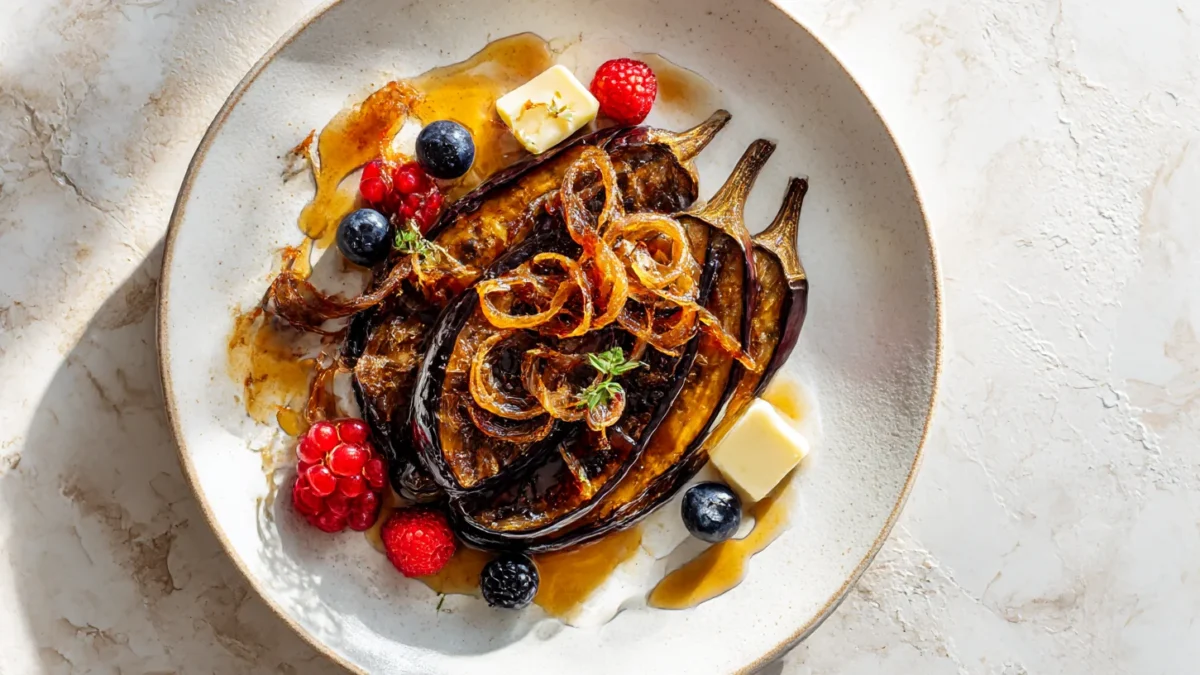
Eggplant is polarizing. People either love it or think they don’t — and the ones who think they don’t have usually only had it overcooked into mush or under-seasoned into a sponge. This miso-glazed eggplant fixes both problems. You roast it hot enough that the outside caramelizes while the inside turns creamy, then brush it with a sweet-salty white miso glaze that gets sticky and browned in the final minutes of roasting. A pile of crispy fried shallots on top gives you salt and crunch. This recipe has made eggplant believers out of more than a few guests at our table.
Why You’ll Love This Miso Eggplant
It’s the vegetable main course that doesn’t feel like a compromise.
- Deep umami flavor — white miso brings savory-sweet intensity that makes eggplant unforgettable.
- Two textures — tender eggplant, crispy shallots.
- Easy to scale — works for two people or a dinner party of eight.
- Make-ahead friendly — fry the shallots up to 3 days ahead.
- Japan-meets-farmers-market — a technique that’s simple but feels restaurant-level.
Ingredients
Look for Japanese eggplant (the long, thin variety) or small globe eggplant. Either works. Japanese eggplant has fewer seeds and thinner skin, so you don’t need to salt it first. If you’re using large globe eggplant, slice it, salt the rounds, and let them sit for 20 minutes — this draws out moisture and any bitterness. Pat dry before roasting.
- 2 lb Japanese eggplant (3–4 long ones), halved lengthwise
- 3 tbsp white (shiro) miso paste
- 2 tbsp mirin
- 1 tbsp rice vinegar
- 1 tbsp honey or maple syrup
- 1 tbsp sesame oil
- 4 large shallots, sliced into thin rings
- ½ cup vegetable oil (for frying shallots)
- 1 tbsp toasted sesame seeds
- Sliced scallions, for garnish
A note on miso
White (shiro) miso is the sweetest, mildest variety — that’s what you want here. Red miso or dark brown hatcho miso will overpower the eggplant. White miso keeps well in the fridge for months. If you can’t find mirin, use 1 tbsp dry sherry mixed with ½ tsp sugar.
Equipment
- Rimmed sheet pan
- Parchment paper or silicone baking mat
- Small saucepan or deep skillet for frying shallots
- Spider strainer or slotted spoon
- Pastry brush (for glazing)
How to Make Miso-Glazed Eggplant
Step 1 — Make the miso glaze (3 minutes)
Whisk together the white miso, mirin, rice vinegar, honey, and sesame oil in a small bowl until smooth. It should be brushable — like maple syrup. If it’s too thick, add 1 tsp of warm water. Set aside. This makes more glaze than you need, but you’ll want extra for drizzling at the table.
Step 2 — Roast the eggplant (20 minutes)
Preheat the oven to 425°F. Line a sheet pan with parchment. Halve the eggplant lengthwise. Score the cut side in a crosshatch pattern (cut diagonal lines about ¼-inch deep, ½ inch apart) — this helps the glaze penetrate and the eggplant cook through evenly. Place cut-side down on the sheet pan. Roast for 15 minutes until the skin is wrinkled and the flesh is starting to soften.
Step 3 — Glaze and roast more (10–15 minutes)
Remove the sheet pan from the oven. Flip the eggplant cut-side up. Brush the scored side generously with miso glaze. Return to the oven and roast for another 10–15 minutes until the glaze is caramelized and bubbling and the eggplant is completely tender when you press it with a fork. If the glaze isn’t bubbling, broil for 2 minutes on the top rack at the end.
Step 4 — Fry the shallots (5 minutes, can be done ahead)
While the eggplant roasts, heat the vegetable oil in a small saucepan over medium heat to 300°F (or until a shallot ring sizzles gently when dropped in). Add the shallot rings in batches — don’t crowd them. Fry for 2–3 minutes, stirring occasionally, until golden brown. With a spider strainer, transfer them to a paper towel-lined plate. Season immediately with a pinch of salt. They’ll crisp up further as they cool. These can be made up to 3 days ahead and stored in an airtight container.
Watch the shallots closely after the 2-minute mark — they go from golden to burnt fast.
Step 5 — Finish and serve
Transfer the glazed eggplant to a serving platter. Drizzle with any remaining glaze. Pile the crispy shallots on top. Scatter sesame seeds and sliced scallions. Serve with steamed jasmine rice.
Pro Tips
Score the cut side. It’s the difference between glaze sitting on top and glaze soaking in. The crosshatch pattern gives you more surface area for caramelization.
Don’t skip the second roast. The first roast is just to soften the eggplant. The second roast (with glaze) is where the flavor happens.
Oil temperature for shallots matters. Too hot and they burn before turning golden. Too cool and they absorb oil and never crisp. 300°F is the sweet spot. If you don’t have a thermometer, a good test: drop in one ring. It should sizzle gently, not aggressively.
Use the leftover glaze. It keeps in the fridge for a week and is incredible on roasted chicken, salmon, or even spread on toast with butter.
Variations & Substitutions
Gochujang glaze (Korean miso swap)
Swap the miso glaze for 2 tbsp gochujang + 1 tbsp soy sauce + 1 tbsp honey + 1 tsp sesame oil. You’ll get a spicier, slightly funkier version that’s phenomenal with the crispy shallots.
Whole roasted eggplant
Use whole small globe eggplant. Prick all over with a fork, roast whole at 425°F for 30 minutes until collapsed, then halve, glaze, and broil. The flesh scoops out smoother.
Grilled version
Grill the eggplant halves cut-side down for 5 minutes, flip, glaze, and grill another 5 minutes lid-down. You get char marks alongside the caramelization.
Vegan version
Swap honey for maple syrup. Everything else is naturally vegan.
Storage & Reheating
Refrigerator: Eggplant keeps 3 days. Store the shallots separately — they lose crunch on the eggplant.
Reheating: Oven at 350°F for 8 minutes to re-crisp. Microwave works in a pinch but won’t re-crisp the glaze.
Shallots: Re-crisp in a 350°F oven for 2 minutes if they’ve gone soft in storage.
What to Serve With Miso Eggplant
A bowl of steamed jasmine rice and you’re done. If you want to build it into a meal, our sushi bowls with spicy mayo complement the Japanese flavors nicely on the table. Our Korean gochujang meatballs make an interesting “East Asian dinner” pairing. Start with our smashed cucumber salad if you want a light first course.
Nutrition Information
Per serving (½ eggplant with shallots): approximately 280 calories, 5 g protein, 32 g carbohydrates, 16 g fat, 8 g fiber. Values are estimates.
Frequently Asked Questions
Can I use red miso instead of white?
Red miso is much stronger and saltier. If that’s all you have, use half the amount and add an extra teaspoon of honey. The result will be saltier but still good.
Do I need to salt the eggplant first?
Only if you’re using large globe eggplant, which has more moisture and can be bitter. Japanese eggplant doesn’t need this step.
Can I air-fry the shallots?
Not well. Shallots need to be submerged in oil to crisp evenly. Baking them gives uneven results. Frying is fast — just 2–3 minutes.
Can I make the glaze ahead?
Yes. It keeps in the fridge for up to a week. It will thicken — just stir in a few drops of water to loosen it before brushing.
If you make this miso eggplant, leave a comment with the miso variety you used — we curious if anyone can find saikyo (sweet Kyoto miso), which would be outstanding here. This is the dish that converted the last two eggplant skeptics at our dinner table. Save it.